There is a reason some spas feel different the moment you walk in. Not better-looking — different. The air feels slower. The silence has weight. This is what authentic wabi-sabi spa design does to a space — and once you understand it, you cannot unsee it in every environment you enter.
Wabi-sabi is not a trend. It is not a mood board aesthetic. Rather, it is a complete philosophy of beauty — one that, when applied to a spa environment, produces a measurable difference in how guests feel before a single treatment has even begun. It is also one of the core reasons why an authentic Japanese spa produces a result that a Japanese-inspired spa simply cannot replicate.
According to the Global Wellness Institute, the wellness economy is now valued at over $5.6 trillion globally — and the spas winning at the premium end are the ones that create environments guests cannot find anywhere else. Wabi-sabi spa design is one of the clearest paths to that outcome.
What Wabi-Sabi Actually Means
Most definitions of wabi-sabi reduce it to something like “the beauty of imperfection.” That is accurate but incomplete — like describing music as “organized noise.”
Wabi-sabi is the Japanese philosophical framework for finding beauty in things that are incomplete, impermanent, and imperfect. It emerged from Zen Buddhism and the Japanese tea ceremony tradition, where a cracked ceramic bowl was more valuable than a flawless one — because the crack told a story, held history, and reminded the viewer of time passing.
The two characters carry distinct meaning:
Wabi — the quiet beauty of simplicity. The rough texture of a stone. The unfinished edge of a wooden beam. The feeling of being alone in nature without loneliness. Wabi is understated and does not announce itself.
Sabi — the beauty that comes with age and use. The patina on old bronze. Moss on a garden stone. The worn path through a forest. In other words, sabi is what happens when time touches something and leaves its mark honestly.
Together, wabi-sabi creates an aesthetic of accepting reality as it is — not polishing it, not hiding it, not forcing it toward an ideal. In a world of marble lobbies and spotless surfaces, this approach is genuinely radical.
Why Wabi-Sabi Spa Design Matters for Guest Experience
A standard luxury spa is designed to signal perfection. Flawless surfaces. Symmetrical arrangements. Lighting engineered to make everything look its best. The message, intentional or not, is: everything here is ideal.
However, there is a problem with this approach. The human nervous system does not relax in the presence of perfection — it performs. It adjusts. It tries to match the standard of the environment. As a result, a guest who walks into a space that looks perfect will spend a portion of their mental energy maintaining themselves in relation to that perfection, whether they are aware of it or not.
Wabi-sabi spa design creates the opposite effect. When a space contains natural materials with visible grain, surfaces that show age, and lighting that acknowledges shadow rather than eliminating it — the nervous system receives a fundamentally different message: nothing here needs to be fixed. Including you.
This is not philosophy for its own sake. It is, in fact, the neurological precondition for deep rest. Research published by the National Institutes of Health supports the connection between environmental design and the depth of physiological relaxation a body can reach. Therefore, before a therapist even touches a guest, the environment has already begun the work — or it has not.
The Five Elements of Wabi-Sabi Spa Design
Understanding wabi-sabi is one thing. Applying it to a physical spa environment, however, requires knowing which specific design decisions activate its effect. These are the five that matter most.
1. Natural Materials With Visible Character
Polished stone hides what stone actually is. Unfinished wood, on the other hand, reveals what wood has been through. In a wabi-sabi spa design, materials are chosen not because they look perfect but because they carry the quality of having existed in the natural world.
For example, this means cedar with visible grain, linen that wrinkles, clay walls with slight irregularity in texture, and river stones with their natural surface intact. Each of these tells a guest, without words, that they are in the presence of something real.
2. Asymmetry Over Symmetry
The Western design instinct tends toward balance and symmetry — two matching lamps, a centered artwork, identical chairs on either side of a table. Wabi-sabi, in contrast, deliberately disrupts this. A single lamp placed slightly off-center. An arrangement of three objects rather than two or four. Space that is intentionally uneven.
As a result, asymmetry creates movement in a room. It draws the eye without demanding it and produces a subtle sense of dynamic calm — the feeling of something alive rather than arranged.
3. Controlled Shadow
Most spa design focuses on light — how to maximize it, direct it, and soften it. Wabi-sabi spa design, however, is equally interested in shadow. In traditional Japanese aesthetics, shadow is not the absence of light. It is an element in its own right.
A treatment room designed with wabi-sabi principles will therefore have areas of genuine darkness — not manufactured by dimmer switches, but created by the architecture itself. The shadow in the corner of the room. The space beneath a low table. The ceiling that the light does not fully reach. These shadows give the room depth and, consequently, make the lit areas feel warmer by contrast.
4. The Sound of Nothing
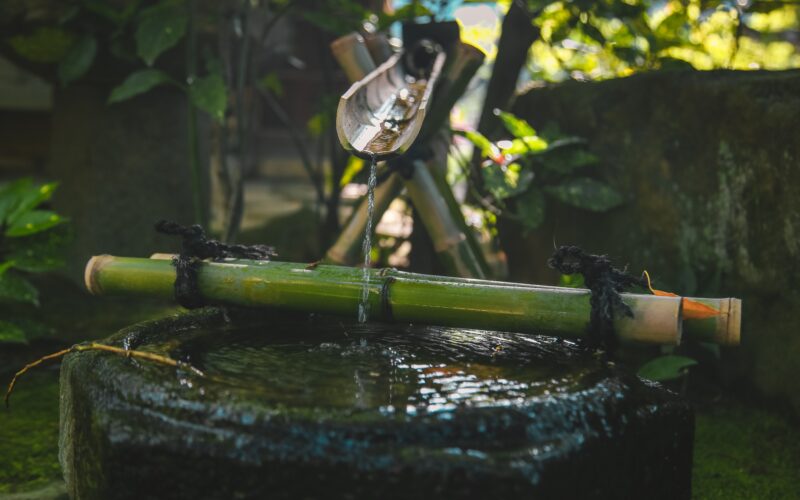
This element is not visual, which is why most spa designers miss it entirely. Wabi-sabi requires silence — not the absence of music, but the presence of acoustic space. The sound of a room breathing. The distant sound of water that you hear and then are not sure you heard.
In a wabi-sabi spa design, sound is treated with the same precision as light. What sounds are present? At what volume? From what direction? Furthermore, what is allowed to be quiet? These decisions shape the guest’s experience as much as anything they can see.
5. Transience Made Visible
Wabi-sabi honors the fact that things change and eventually end. In a spa context, this means incorporating elements that shift — seasonal flowers that will fade, candles that burn down, incense that disperses into the air and disappears. These are not merely decorative choices. They are philosophical ones.
When a guest notices a single stem in a vase that is just beginning to turn, something in them recognizes their own transience — and relaxes into it. This is, consequently, one of the most powerful and least understood mechanisms in Japanese wellness design.
What Wabi-Sabi Spa Design Is Not
Because the phrase has entered mainstream design vocabulary, it is worth being clear about what wabi-sabi spa design does not mean.
It does not mean deliberately ugly. Wabi-sabi is about choosing materials that are honest about what they are and allowing them to age with dignity — not about neglecting maintenance or choosing inferior quality.
Nor does it mean minimal in the Western sense. Minimalism removes things to achieve clarity, whereas wabi-sabi chooses things that carry meaning. There may be fewer objects, but each one is present for a reason.
Wabi-sabi spa design is also not a cheap alternative. Authentic natural materials — unfinished timber, handmade ceramics, natural linen — often cost more than their manufactured equivalents. This is a value decision, not a budget one.
And finally, it does not mean Japanese-looking. A wabi-sabi space does not require shoji screens or bamboo. Instead, it requires the philosophical approach — materials chosen for honesty, imperfection embraced rather than hidden, and transience acknowledged rather than denied.
The Business Case for Wabi-Sabi Spa Design
The business case for wabi-sabi spa design comes down to three things — and all three are directly connected to revenue.
Differentiation that cannot be copied. Any spa can install a Japanese-style reception desk. However, no spa can fake the quality of a space that was designed with genuine philosophical intention. Guests who have experienced real wabi-sabi environments recognize the difference immediately, even if they cannot articulate it. This creates loyalty that aesthetics alone cannot.
Higher tolerance for price. A guest who feels genuinely different — whose nervous system has actually shifted in your space — does not comparison-shop. Moreover, they return and pay what the experience is worth, because they know they cannot find it elsewhere.
Word of mouth that works. The most powerful marketing for a wellness business is a guest who tells someone else: I cannot fully explain it, but something about that place is different. Wabi-sabi spa design is one of the primary creators of that experience. As a result, it produces a feeling that guests carry with them and talk about — because they cannot quite name it.
For investors who want to understand what this means at the investment level, the full commercial picture of a Japanese spa for business covers the numbers in detail.
How to Begin Incorporating Wabi-Sabi Spa Design
Incorporating wabi-sabi spa design into your space does not start with a renovation. Instead, it starts with a question.
Look at your space and ask: what here is pretending to be something it is not?
Surfaces designed to hide their material. Lighting that makes everything look equally bright. Arrangements that are symmetrical because symmetry signals control. Sounds that fill every moment because silence feels like something is missing.
Begin by removing what is pretending. What remains will often already have the quality you are looking for. Furthermore, what needs to be added will be easier to choose once you know what you are choosing for.
The Deeper Point
Wabi-sabi spa design is not a style. It is, at its core, a practice of honesty — with materials, with space, and with the nature of things. When applied to a spa environment with genuine understanding, it creates something that no amount of budget or technical skill can manufacture: a space where guests feel permission to stop performing and simply exist.
That permission is, in the end, what every person who walks into a spa is looking for. Most spas cannot give it, because their design is asking guests to admire rather than rest. A wabi-sabi spa, however, gives it before the first treatment even begins.
Okawari is a Japanese luxury wellness concept based in Osaka, Japan. We transfer the complete system of authentic Japanese wellness — philosophy, design, and technique — to international spa owners and hospitality investors. If you are considering bringing something genuinely different to your market, begin the conversation here.