Japanese Sound Therapy: Close your eyes for a moment and imagine three sounds. The slow, resonant decay of a koto string — a note that arrives gently and takes its time leaving. The sound of shallow water moving over smooth stones, irregular and continuous. Wind through the upper branches of tall trees, never quite the same twice but always recognizably itself.
Notice what happened to your breathing while you read that. If it slowed slightly, or you became briefly aware of your exhale — that is not imagination. That is your nervous system responding to acoustic information in exactly the way it was designed to.
Japanese sound therapy is built around this response. Not as a wellness trend or a marketing concept. Japanese practitioners have worked with this relationship for centuries. The neuroscience that explains why it works is considerably more recent — and it confirms, in clinical terms, what traditional practice has always known experientially.
Why Japanese Sound Therapy Affects the Body So Directly
Most people think of hearing as a conscious experience. We listen to music. We choose to pay attention to sounds we find interesting. We filter out sounds we do not want to hear.
This model is incomplete. The auditory nervous system does not wait for conscious attention before it begins responding to sound. Signals travel from the cochlea to the brainstem, the amygdala, and the hypothalamus — before reaching the cortex where conscious perception happens. In practical terms, your nervous system responds to the acoustic environment before you have formed an opinion about whether you like what you are hearing.
Research published by the National Institutes of Health documents this pathway extensively. The amygdala receives direct acoustic input. Sounds that register as biologically threatening activate the stress response before any conscious thought is possible. Conversely, sounds that register as biologically safe — slow, low-frequency sustained tones, water sounds, certain harmonic structures — deactivate the threat response and allow the parasympathetic system to engage.
Japanese sound therapy works because its primary instruments and natural sound sources sit precisely in the frequency ranges that produce that second response.
The Koto: A String That Teaches the Nervous System to Rest
The koto is Japan’s national instrument — a 13-string zither played in Japanese musical tradition for over a thousand years. Its design has remained essentially unchanged. The acoustic properties it produces are, in the context of Japanese sound therapy, close to ideal.
A koto note has several characteristics that distinguish it from most Western instruments. The attack is extremely gentle. The note arrives without percussion, without a sharp onset that triggers the alerting response. The sustain is long and harmonically rich. The decay is gradual and consistent, without the sudden drop-off that prompts the nervous system to prepare for what comes next.
According to Healthline, sustained tones in the low-to-mid frequency range activate the parasympathetic nervous system. The koto consistently produces tones in this range. Furthermore, the gentle decay of a koto note allows the nervous system to release its alertness gradually rather than abruptly. This is why listening to koto produces a quality of stillness that accumulates over time rather than arriving all at once.
In a japanese sound therapy context, koto is often used in the middle phases of a treatment — after the guest has settled, when the intention is to deepen the physiological shift already begun by the environment and early treatment work.
Water Sounds: The Frequency of Safety
Water sounds appear across many wellness traditions. However, japanese sound therapy is specific about which water sounds — and why.
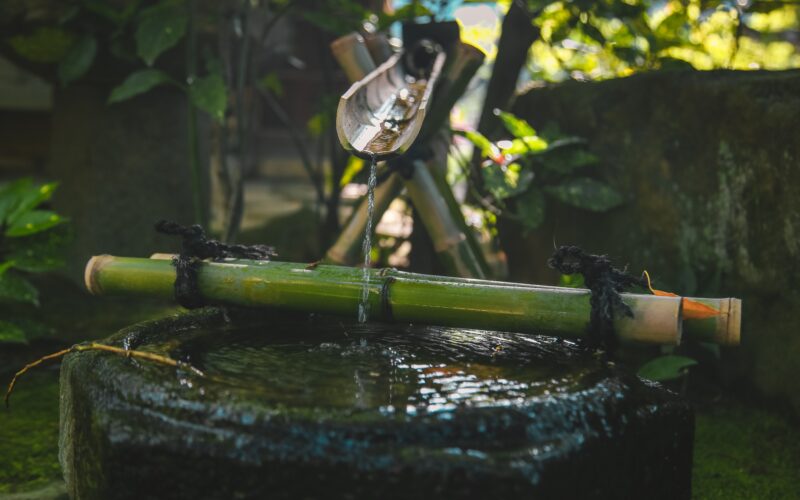
The sounds that produce the deepest parasympathetic response are not dramatic water sounds. Waterfalls and ocean waves in full volume contain a degree of unpredictability that keeps the nervous system partially alert. The sounds used in japanese sound therapy are quieter and more rhythmically consistent. Water moving slowly over stones. Water filling a vessel in an irregular but gentle stream. Rain on leaves when it is soft enough to hear individual drops.
These sounds share a specific characteristic: they are continuous without being uniform. The nervous system reads this pattern as fundamentally safe — the acoustic signature of a natural environment where nothing threatening is happening. According to research cited by Psychology Today, this kind of sound environment reduces activity in the default mode network. That is the part of the brain associated with rumination, self-referential thought, and the low-level mental activity that prevents genuine rest.
Forest Sounds: Shinrin-Yoku in Acoustic Form
The Japanese practice of shinrin-yoku — forest bathing — is now widely known in Western wellness contexts. Research documenting its physiological effects is substantial. What is less understood is that a significant portion of those effects come from the acoustic environment of the forest — not from any other sensory element.
Forest sounds produce a physiological response that has been documented extensively. Blood pressure decreases. Cortisol drops. Heart rate variability improves, indicating a more resilient autonomic nervous system.
The specific frequencies matter. The rustling of leaves falls in a frequency range the auditory system reads as non-threatening background variation. The mid-range birdsong that populates forest environments sits in a frequency band associated with positive emotional response and attentiveness without arousal.
In japanese sound therapy, forest sounds are often used in the arrival phase of a treatment experience. The intention is to begin the guest’s transition from their external environment to the internal, resting state that the treatment will deepen. As the guest sits with these sounds before the treatment begins, their nervous system starts the shift from alert to rest.
How These Elements Work Together in Japanese Sound Therapy
The most sophisticated application of japanese sound therapy is not any single sound element. It is the designed sequence of multiple elements — the way koto, water, and forest sounds are layered, alternated, and resolved across the arc of a full treatment experience.
A well-designed japanese sound therapy sequence might begin with forest sounds during arrival. Water sounds enter during preparation. Koto arrives during active treatment. A quieter combination of water and silence holds the integration phase. Each phase serves a specific purpose. The transitions between phases are as carefully considered as the phases themselves.
This is fundamentally different from playing a Japanese wellness playlist at moderate volume. It is a treatment protocol applied to the acoustic channel — and it produces results that passive ambient music cannot.
What This Means for Your Spa
If you are a spa owner curious about how these principles might apply to your environment, start with a simple audit.
Spend 20 minutes in your treatment room with your eyes closed when the room is not in use. What do you hear? What frequency range does it occupy? Is there genuine silence, or does ambient sound fill every moment? When music plays, does it arrive with force or with gentleness? Does it ever pause?
Your honest answers will tell you more about your spa’s acoustic environment than any formal analysis. For the full picture of how sound therapy sits within broader Japanese wellness philosophy — including the role of noble silence and the principles of ma — the Okawari approach offers a framework that most operators have not encountered elsewhere.
Okawari transfers the complete system of authentic Japanese wellness — including its acoustic philosophy — to international spa owners and hospitality investors. Visit okawarispa.com/enquire.