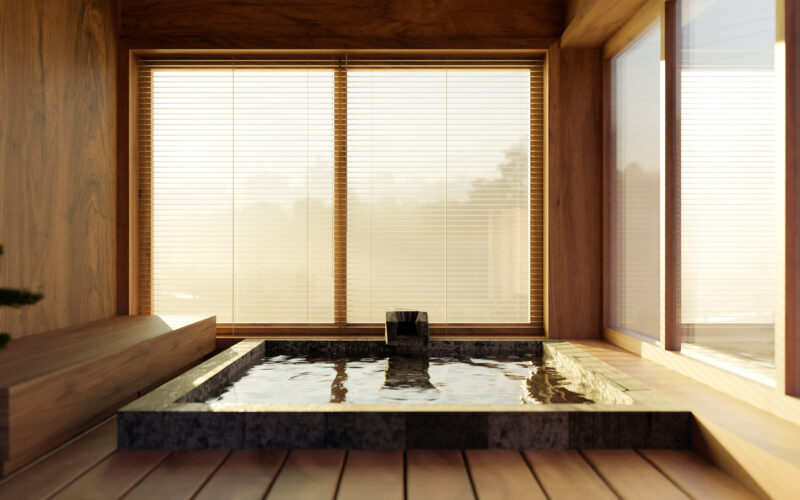
The luxury wellness market in Southeast Asia is growing faster than almost any other hospitality segment. Investors looking to open a Japanese spa for business are discovering a significant opportunity — but only for those who understand the difference between a spa that looks Japanese and one that actually delivers authentic Japanese wellness.
According to the Global Wellness Institute, the wellness economy is now valued at over $5.6 trillion globally, with Asia Pacific among the fastest-growing regions.
But most spa businesses look the same — the same treatments, the same aesthetic, the same result. Investors who want to stand out are asking a different question: not how do I open a spa, but how do I open a spa that guests cannot find anywhere else?
The answer, increasingly, is Japan.
A Japanese spa for business is not just an aesthetic choice. It is a strategic one. Japanese wellness is rooted in philosophy, precision, and a measurable physiological outcome that standard spa treatments simply do not produce. For investors in Singapore, Thailand, Malaysia, Indonesia, and beyond, this difference is now a competitive advantage — and a commercial one.
What Makes a Japanese Spa Different From Other Luxury Spa Concepts
Most luxury spas compete on surface. Beautiful interiors. Trained therapists. Premium products. These are table stakes — necessary, but not sufficient to build loyalty or justify premium pricing in 2025.
A Japanese spa operates on a different principle: that the environment, the sound, the silence, and the technique work together as a single system. Remove one element and the outcome changes. This is not philosophy for its own sake. It is the reason guests return.
The three pillars of authentic Japanese wellness are:
1. Luxury Wellness as a Standard
Japanese wellness is not a service category. It is a standard of precision — where every detail, from the temperature of the room to the weight of silence before a treatment begins, is calibrated to produce complete neurological rest in the guest. This is what separates a Japanese spa from a spa that looks Japanese.
2. Wabi-Sabi Philosophy
Wabi-Sabi is the Japanese aesthetic of imperfect beauty — the moss on the stone, the crack in the ceramic, the pause between two notes. When applied to a spa environment, it creates a sensory experience that guests feel but cannot easily describe. They simply know that the space is different. That knowing drives return visits.
3. The Sound of Treatment
Sound is the element most Western and Southeast Asian spas overlook entirely. In authentic Japanese wellness, precisely curated sound frequencies — the resonance of koto, the rhythm of water, the breath of forest — enter the nervous system before touch begins. Clinical data shows this combination reduces cortisol levels by up to 37% more than technique alone.
Research published by the National Institutes of Health supports the role of acoustic therapy in reducing physiological stress markers when combined with manual treatment.For guests who have experienced everything, this is the difference they have been looking for.
The Business Case: Why Southeast Asian Investors Are Moving Now
The Market Is Underserved at the Top End
Southeast Asia has no shortage of spas. What it lacks is authentic Japanese wellness — not the aesthetic, but the system. Investors who move early to establish a genuinely differentiated Japanese spa concept will own a category that competitors cannot easily replicate.
Premium Pricing Is Justified and Sustainable
A Japanese spa for business is not a race to the middle. Guests who experience authentic Japanese wellness understand they are receiving something fundamentally different. This supports treatment pricing 40–60% above market average — not as a premium, but as an accurate reflection of the outcome being delivered.
Guest Retention Is Structurally Higher
Standard spa guests visit occasionally. Guests who experience neurological rest through authentic Japanese methodology return on a schedule. They also refer. The referral rate among guests of properly delivered Japanese wellness programs is significantly higher than industry average — because the experience is genuinely difficult to explain and impossible to replicate at home.
The Concept Transfers Completely
One of the most common concerns among hospitality investors considering a Japanese wellness concept is authenticity: Can this be delivered outside Japan? The answer, when the methodology is properly transferred, is yes. The system is not dependent on geography. It is dependent on training, philosophy, and operational precision — all of which can be installed in any market by the right partner.
What to Look for in a Japanese Spa Partnership Program
Not all Japanese spa concepts are equal. When evaluating a partnership, investors should assess four areas:
Depth of Curriculum
A genuine Japanese wellness program trains therapists in philosophy, anatomy, and technique — not technique alone. The philosophy shapes every decision: how the room is prepared, how the therapist enters, how silence is used as a tool. Without the philosophy, the technique produces ordinary results.
Proof of Commercial Viability
The methodology should have a track record in a commercial setting — not just a hotel spa or a single practice, but a scalable business with documented revenue outcomes. Any serious partner should be able to demonstrate this.
Training and Ongoing Support
Opening the spa is the beginning, not the end. The best Japanese spa business models include ongoing training, quality standards enforcement, and access to the original practitioner’s knowledge base. This is what protects the investment over time.
Exclusivity and Differentiation
If the same concept is available to every competitor in your market, the differentiation disappears. Evaluate whether the program offers territorial protection and genuine scarcity — both of which preserve your competitive position.
Is a Japanese Spa Right for Your Business?
A Japanese spa for business is the right investment if:
- You operate or are building a hotel, resort, or wellness destination where the guest experience is the core value proposition
- You are a spa or salon owner looking to move into the luxury segment with a genuinely differentiated offering
- You are an investor seeking a wellness concept with documented methodology, commercial proof, and long-term guest retention built into the model
It is not the right investment if you are looking for a fast-setup, low-training spa concept. Japanese wellness requires operational discipline and philosophical commitment. The return is significant — but it requires a partner and a team who understand what they are delivering.
Next Steps
Okawari is a Japanese luxury wellness concept built over fourteen years by founder Megumi Takeda — a practitioner, anatomist, and school operator who has delivered over ten thousand treatments and trained more than three thousand therapists across Japan.
The Okawari partnership program transfers the complete system — philosophy, curriculum, technique, and operational standards — to a select number of international partners each year. Enquiries from Southeast Asian spa owners, hotel operators, and hospitality investors are currently open.
If you are building something that requires authenticity at its foundation, the conversation starts here.
Okawari is operated by CEOL Academy Japan®, Osaka, Japan. Partnership enquiries: info@okawarispa.com