Most spas have music playing. Some of it is quite good — carefully selected, thoughtfully mixed, genuinely pleasant to sit with during a treatment. Walk into most high-end spas in Singapore, London, or New York, and you will hear something vaguely Asian, vaguely ancient, and vaguely calming. None of it is sound healing japanese spa work. Not even close.
Background music and deliberately designed acoustic therapy are two different things. One is an aesthetic choice. The other is a treatment decision. Spa owners who understand this distinction build something different from those who simply add “Japanese sound healing” to their menu.
The acoustic environment shapes what a guest’s nervous system does during treatment. Get it right, and the body drops into genuine rest. Get it wrong, and the treatment works against itself — no matter how skilled the therapist.
What Sound Does to the Body
Before getting into what Japanese sound healing is, it is worth understanding the mechanism — why sound matters at all as a treatment element.
The human nervous system does not experience sound the way we think it does. We tend to think of hearing as a passive sense — sound arrives, we perceive it, we react if we choose to. But the auditory system has a direct neurological pathway to the amygdala, the part of the brain responsible for threat assessment and stress response. Sound bypasses cognitive processing entirely. It arrives before the thinking mind has a chance to evaluate it.
This means that the acoustic environment of a spa is affecting a guest’s nervous system from the moment they enter — whether the operator intended it or not. The question is not whether sound is doing something to your guests. It is whether what it is doing is what you want.
Research published by the National Institutes of Health has consistently documented the relationship between specific sound frequencies and physiological states. Low-frequency sounds activate the parasympathetic nervous system. Irregular, unpredictable sounds activate the stress response. Certain harmonic structures reduce cortisol measurably. Others, even at low volumes, maintain a low level of alertness that prevents the depth of rest a guest needs for genuine recovery.
Most spa music is chosen for how it sounds. Japanese sound healing is chosen for what it does.
The Instruments That Matter and Why
Japanese wellness tradition uses a specific set of instruments whose acoustic properties happen to align closely with what the research shows produces the deepest physiological rest. This is not coincidence — these instruments developed over centuries in a culture that prioritized the quality of presence and stillness they create.
Koto — Japan’s oldest stringed instrument. The koto produces a resonant, sustained tone with a natural decay that the nervous system reads as safe. There is no attack in a koto note — it arrives without aggression and fades without urgency. For a nervous system that has been in a state of low-level alertness all day, a koto note is almost the opposite of what it has been receiving.
Shakuhachi — the bamboo flute. The shakuhachi produces an breathy, slightly imperfect tone that resembles the sound of breath itself. Listening to shakuhachi activates the same neurological pathways as slow, diaphragmatic breathing — which is part of why practitioners of zen meditation have used it for centuries. It does not make you think of breathing. It makes your body do it.
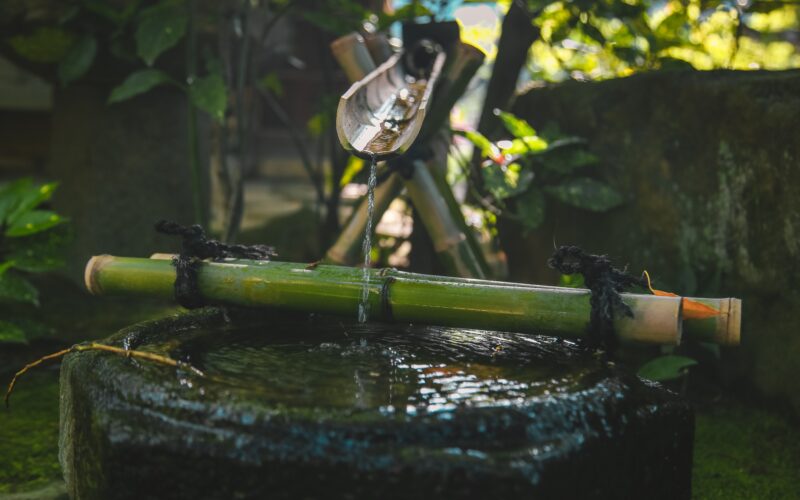
Water sounds — specifically, the sound of water moving slowly. Not the dramatic sound of a waterfall, which activates attention and alertness. The sound of water flowing over stones, or filling a vessel slowly — sounds with a very specific frequency range that the nervous system reads as fundamentally safe. These are sounds humans evolved alongside. They mean: nothing is hunting you right now.
Silence between sounds — this is not an absence but an element. In Japanese music, the space between notes is as deliberately constructed as the notes themselves. For the nervous system, this silence allows the previous sound to fully resolve before the next one arrives. It is the acoustic equivalent of ma — the meaningful use of empty space — and it is what separates Japanese sound healing from ambient music that simply avoids silence because silence feels uncomfortable.
How Japanese Sound Healing Is Used in Treatment
In a Japanese spa that genuinely incorporates sound healing, the acoustic environment is designed as a sequence — not a playlist. There is a beginning, a middle, and an end, and each phase of the sound environment corresponds to a phase of the guest’s physiological journey.
The arrival phase introduces the space before a word is spoken. The sound environment tells the nervous system: you are somewhere different now. The familiar auditory landscape of daily life — traffic, conversation, notifications, the ambient hum of urban infrastructure — is replaced by something that the body reads as genuinely restful.
The treatment phase uses sound as a complement to touch, not a backdrop to it. A practitioner who understands sound healing will time certain movements with the natural resolution of a koto phrase. The body receives touch and sound simultaneously, and the combined effect is different from either one alone. According to Healthline, multi-sensory therapeutic environments produce deeper physiological relaxation than single-modality approaches — and the Japanese wellness tradition has understood this empirically for centuries.
The integration phase, after active treatment, uses the sound environment to hold the guest in stillness. This is not nothing. This is the period when the body processes and integrates what it has just received. The wrong sound environment at this point can undo significant work. The right one extends the depth of rest for minutes after the therapist has left the room.
Why Most Spas Get This Wrong
The challenge with sound healing in a spa context is that it looks easy from the outside. Find some Japanese music, play it at a low volume, and guests will describe the experience as “so calming.” They will not be lying — they will feel calmer than they would in a spa with no music at all.
But that is not the ceiling. That is the floor.
The ceiling — the depth of rest that a genuinely designed acoustic environment can produce — is something most spa guests have never experienced. And most spa operators have never created it, because creating it requires understanding what sound is actually doing at the neurological level, not just how it sounds.
Most spas choose their music the way they choose their candle scent: through preference and intuition, with a bias toward things that feel Japanese, or calm, or luxurious. This is understandable. It is also why the gap between most spa sound environments and what a genuine Japanese sound healing approach produces is so significant.
What to Listen For
If you want to develop a better ear for what makes a sound environment therapeutically effective versus merely pleasant, pay attention to a few specific things next time you are in a spa.
Does the music have attack — notes that arrive sharply and demand attention? Or does it have the slow arrival and natural fade of instruments like the koto? Does the room ever go genuinely quiet, or is the music continuous? When silence arrives — even briefly — does your body experience it as relief or discomfort?
These are the questions a Japanese sound healing practitioner asks when designing an acoustic environment. The answers tell you a great deal about what the space is actually doing to the nervous system of everyone who enters it.
The Larger Point
Sound is not the most visible element of a spa experience. Guests rarely list it first when they describe what they loved about a treatment. But it is, in many ways, the most physiologically significant environmental factor — because it operates below conscious attention and directly influences the depth of rest a body can reach.
A spa that understands wabi-sabi design principles understands that every sensory element of a space is either working toward rest or working against it. Sound is no different. And in the context of authentic Japanese wellness, it is one of the primary reasons the outcome is different from anything most guests have experienced before.
Okawari transfers the complete system of authentic Japanese wellness — including the acoustic philosophy that most concepts leave out — to international spa owners and hospitality investors. To learn more, visit okawarispa.com/enquire.